
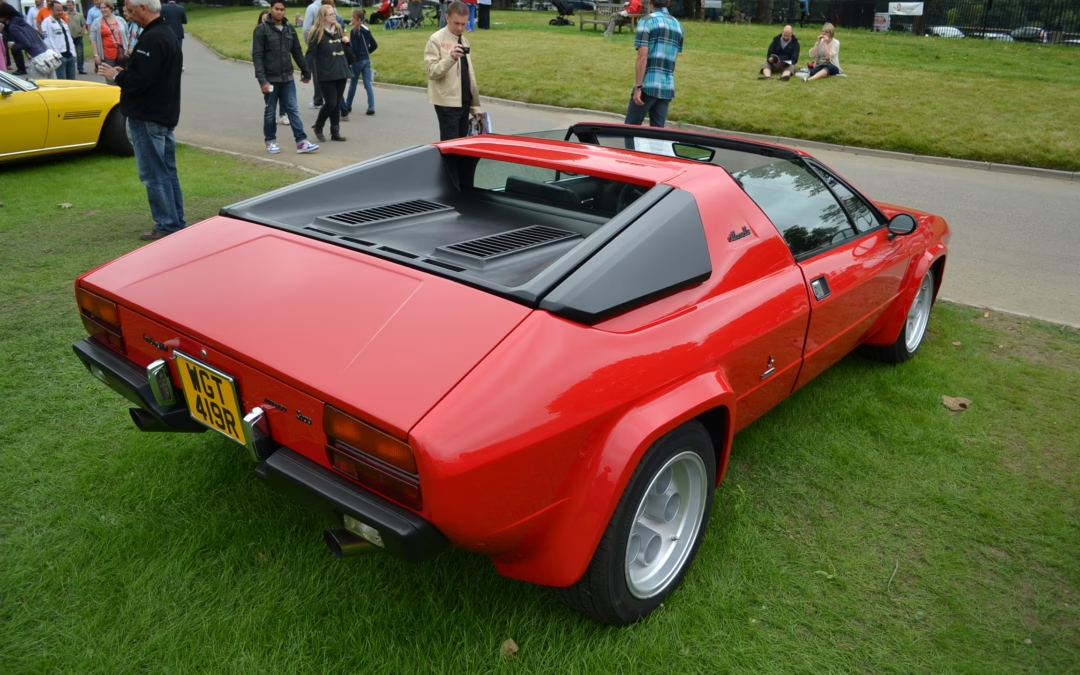
It is the rarest production Lamborghini ever made. It saved the V8 lineage and paved the way for the open-top raging bulls of today. Yet, you’ve probably never seen one.
In the pantheon of Lamborghini legends, the spotlight naturally gravitates toward the V12 heavyweights. The Miura invented the supercar; the Countach defined the poster-car era; the Diablo became the icon of the 90s. But hiding in the dark corners of Sant’Agata’s history is a car that, by sheer numbers, makes the Miura look common.
Meet the Lamborghini Silhouette P300.
Built between 1976 and 1979, only 54 units ever left the factory (some sources say as few as 52). It was a car born of desperation during Lamborghini’s darkest financial hour, yet it emerged as a styling triumph that would define the “baby Lambo” aesthetic for a decade.
The Urraco Goes to the Gym
To understand the Silhouette, you must first look at the Urraco. By the mid-70s, the 2+2 Urraco was struggling to fight off the Ferrari 308 GT4 and the Porsche 911. Lamborghini needed something sharper, sexier, and—crucially for the American market—open-topped. With no money for a clean-sheet design, Lamborghini turned to the magician of Turin, Marcello Gandini at Bertone. His mandate: take the Urraco and make it aggressive.
Gandini delivered a masterclass in the “facelift.” He deleted the Urraco’s rear seats, turning the car into a strict two-seater. He chopped the roof to create Lamborghini’s first-ever Targa top, a feature that allowed the V8’s song to fill the cabin.But the real visual drama came from the “widebody” treatment. The Silhouette featured boxed-out, angular wheel arches that gave it a muscular, hunkered-down stance. These arches housed massive Campagnolo “phone-dial” wheels (15×8 front, 15×11 rear) wrapped in Pirelli P7 rubber—a wheel design that would later become legendary on the Countach S.
The Heart of the Bull
Beneath the louvers sat a transverse-mounted, 3.0-liter, all-aluminum V8. Derived from the Urraco P300, it was a jewel of an engine.
- Engine: 3.0L DOHC 90° V8
- Power: 265 bhp @ 7,500 rpm
- Torque: 201 lb-ft @ 3,500 rpm
- 0-60 mph: ~6.5 seconds
- Top Speed: 162 mph
While 265 horsepower sounds modest by modern standards, in 1976 it was electric. The Silhouette weighed just over 2,700 lbs. Without power steering or electronic nannies, the driving experience was visceral. Contemporary reviews praised its neutral handling and the linear pull of the V8, noting it felt “tamer” than the big V12s but sharper than its competitors.
The Lost Years
So, why did it fail?
Timing is everything. The Silhouette launched just as Lamborghini was collapsing into bankruptcy. The company was in such disarray that they failed to get the car homologated for the U.S. market—the very market the Targa top was designed to seduce. Without American sales, the Silhouette was doomed to obscurity.
Production halted in 1979. For two years, the factory went silent on the V8 front, until the Silhouette’s chassis and engine were dusted off, smoothed out, and rebranded as the Jalpa in 1981. The Jalpa went on to sell over 400 units, becoming the “successful” V8 Lambo, but it owed its entire existence to the groundwork laid by the Silhouette.
A Modern Unicorn
Today, the Silhouette is the holy grail for Lamborghini collectors. Finding one is nearly impossible; it is estimated that fewer than 35 survive globally. Visually, it has aged arguably better than the Jalpa. The Silhouette’s sharp creases and aggressive wheel arches feel more “pure 70s” than the plastic-clad bumpers of the 80s Jalpa. It represents a fleeting moment where Bertone’s wedge design language was at its absolute peak—raw, mechanical, and unfiltered.
If you ever see one at a Concours, stop and take a look. You are staring at the bridge between the past and the future—the car that kept the lights on just long enough for the bull to survive.